The Intended's enduring grief
Heart of DarknessThe Intended’s enduring grief makes mourning feel both prolonged and newly present: more than a year after Kurtz’s death, she receives Marlow as though the loss had happened only yesterday. Her sorrow is bound to an idealized memory of Kurtz, yet the scene also shows its force shaping what Marlow can tell her. When she asks for a last word to live with, he conceals the truth and says that Kurtz’s final word was her name.
Duration and the Scene of Mourning
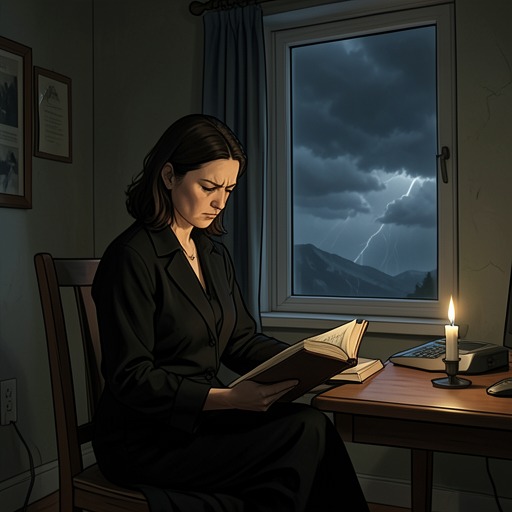
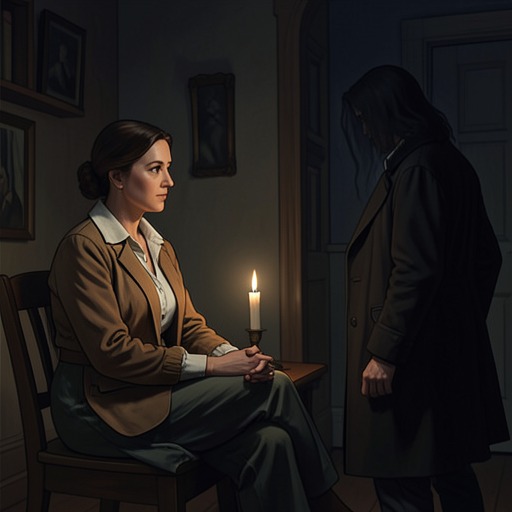
The Intended meets Marlow dressed entirely in black, with a pale head and a sorrowful bearing. The news of Kurtz’s death had reached her more than a year earlier, but Marlow sees no corresponding distance in her grief. He describes her as someone with a mature capacity for fidelity, belief, and suffering, and reads her as a person whom time does not easily alter. The passage does not establish how she has lived through the intervening months; instead, it makes the persistence of loss visible in the present encounter.
That persistence is conveyed through the contrast between elapsed time and felt time. As The Intended takes Marlow’s hands, the look of desolation on her face makes him feel that Kurtz died not merely yesterday but at that very moment. The narrative joins her sorrow to the instant of death: Marlow says he sees them together, her grief and his death. Her mourning therefore appears not as a memory that has settled into the past, but as an experience repeatedly brought back into the present. When she later says that she cannot believe she will never see Kurtz again, her repeated “never, never, never” gives verbal form to a loss that she cannot absorb as final.
A Private Loss Made Larger
The Intended’s grief is intensely personal, but her language repeatedly enlarges its scope. She first calls Kurtz’s death a loss to herself, then corrects herself to include others, and finally says it is a loss to the world. Her formulation moves from intimate bereavement toward a public judgment of his importance. The tears in her eyes do not fall; the restraint of the image makes sorrow present without offering release.
Her account of what has been lost is also an account of the Kurtz she remembers. She speaks of his promise, greatness, generous mind, and noble heart, and says that nothing remains but memory. She recalls his example and the goodness she believes shone in his actions. When she insists that people were drawn to him by what was best in themselves, grief and admiration reinforce one another: the dead man becomes not only someone loved but a source of moral inspiration. Her conviction is not presented as a settled appraisal shared by all witnesses. Marlow answers by repeating her claim about Kurtz’s example, while inwardly aware of a darker knowledge that he cannot bring himself to disclose.
Marlow as Witness and Intermediary
The scene’s account of grief is filtered through Marlow’s retrospective narration. He does not simply report The Intended’s words; he describes how her sorrow alters his own sense of time and how her faith confronts what he knows. Her mourning makes him feel that Kurtz has died again in the room, while the last cry he associates with Kurtz returns to him as a whispered condemnation. The difference between her vision of Kurtz and Marlow’s knowledge is thus staged as a conflict inside the act of witnessing.
The Intended asks Marlow to repeat Kurtz’s final words because she wants “something—to live with.” Her request gives his silence an immediate human consequence: answering truthfully would replace the consoling image she holds with the words Marlow remembers. She then says, “I loved him—I loved him—I loved him!” The repetition makes the depth of her attachment unmistakable, but it also sharpens the ethical pressure on Marlow. He is not merely choosing whether to correct a mistaken recollection; he is deciding what to give a bereaved woman who has asked him for one remaining connection to the dead.
The Final Word and the Shape of Grief
Marlow tells The Intended, “The last word he pronounced was—your name.” The statement is a deliberate consolation, not the truth he has been carrying. It gives her a last utterance that confirms the place she believes she held in Kurtz’s life, and allows her to leave the encounter with that belief intact. The scene therefore connects her continuing grief to a particular act of concealment: her request for a word to live with meets Marlow’s decision to substitute a comforting answer for the one he knows.
The lie does not undo her loss or end her mourning. Rather, it preserves a form in which she can continue to remember Kurtz: as the man of promise, noble feeling, and exemplary goodness she has described. Her grief remains poignant partly because it is sincere and partly because its object is protected from contradiction. In Marlow’s telling, the final exchange makes mourning a test of what the living owe the dead and the bereaved. The Intended receives an answer shaped by her devotion, while Marlow remains the witness who knows that the words he gives her are not Kurtz’s actual last words.